Showing posts with label NEWS. Show all posts

Tuesday, April 7, 2020

Jean Baudrillard - Post Modernism theory + application of usefulness

Baudrillard's theory:

- The idea that in postmodern culture, the boundaries between the 'real' world and the world of the media have collapsed and that it is no longer possible to distinguish between reality and simulation.
- The idea that in a postmodern age of simulacra, we are immersed in a world of images which no longer refer to anything 'real'.
- The idea that media images have come to seem more 'real' than the reality they supposedly represent (hyper reality).

This theory relates to the fact that in the media, they influence an idea of historical context which they try to apply to modern day society. For example, the portrayal of women in the media may be that they are supposed to be in the kitchen and/or stay at home to look after the kids.

Applications to:

News:
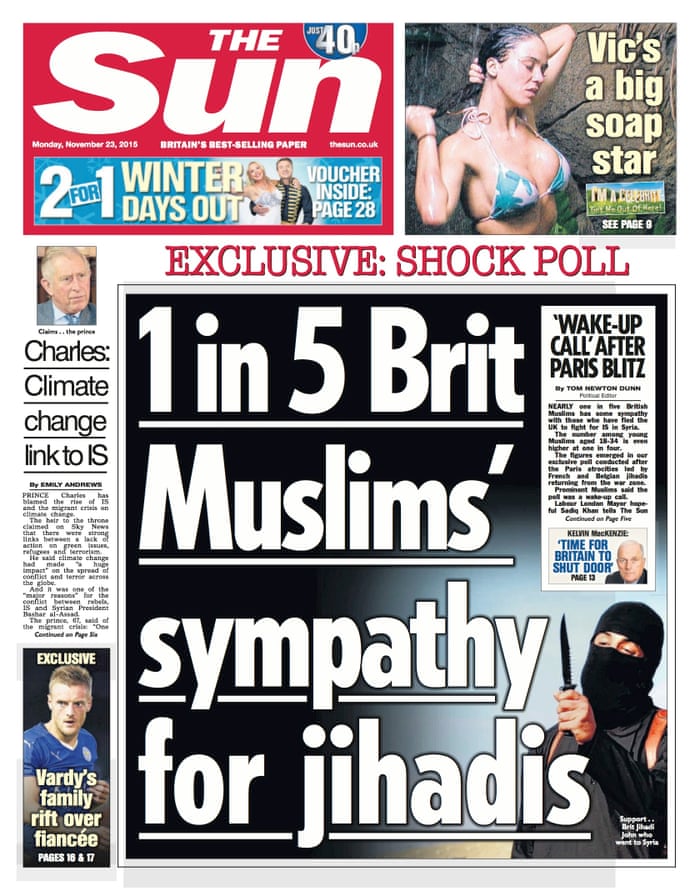
One man's (very polite) fight against media Islamophobia | News ...

TV Drama:

Stranger Things:
Intertextuality is used when referring to the board game that is shown in the first episode - Dungeons and Dragons. Due to this, it aids in referencing the time period that the drama is set in (the 80's). The use of significant effects in the series aids in creating a supernatural/mysterious outlook which emphasises the hyperreality.

Deutschland '83:
-

Usefulness in...

News:
Baudrillard's theory is not as useful when applying it to newspapers as there is not much to talk about in relation to hyperreality. Newspapers tend to give more informative text/factual and objective information (as well as some subjective). therefore, it is a lot harder to link any news stories/topics with the audience finding it hard to determine what is real and what is fantasy.

TV Drama:
Baudrillard's theory is more useful when talking about tv drama's. However, it is not applicable to D83 due to the fact that D83 is very factual and links to the real occurrences in the 1980's in Germany (East and West). On the other hand, the theory can be applied to ST because ST has a more supernatural (and therefore, fantasy/sci-fi) genre. This allows the audience to be able to see things that are real against the things that aren't. For example, Eleven is a normal, young girl in 'care' until you see her powers. Amongst the setting of the 1980's Hawkins (Indiana), it seems like her powers are real.



Tuesday, March 24, 2020

Paul Gilroy - Post Colonialist theory + application of usefulness

Paul Gilroy's theory:

- The idea that colonial discourses continue to inform contemporary attitudes to race and ethnicity in the postcolonial era.
- The idea that civilisationism constructs racial hierarchies and sets up binary oppositions based on notions of otherness.

This theory relates to the fact that society creates racial hierarchies (e.g. white privilege) and sets up oppositions, which becomes the norm. For example, some people believe that white people are better than those of an African or Asian descent.

Paul Gilroy's theory will be relevant to any representation of race and/or ethnicity (and also of Western culture).


Applications to...

News:
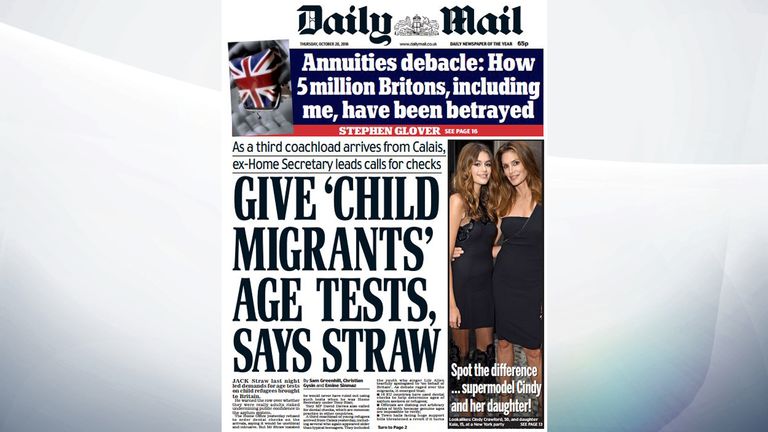
Image result for guardian and daily mail cover on calaisImage result for guardian and daily mail cover on calais

As seen above, the Daily Mail tends to give a stereotypical, negative view of migrants/refugees. They use words like 'swarm' to make the non-British people feel like they don't belong because they haven't originated from Britain. The images used on these front covers reflect the Daily Mail's attitudes towards those who are less fortunate.
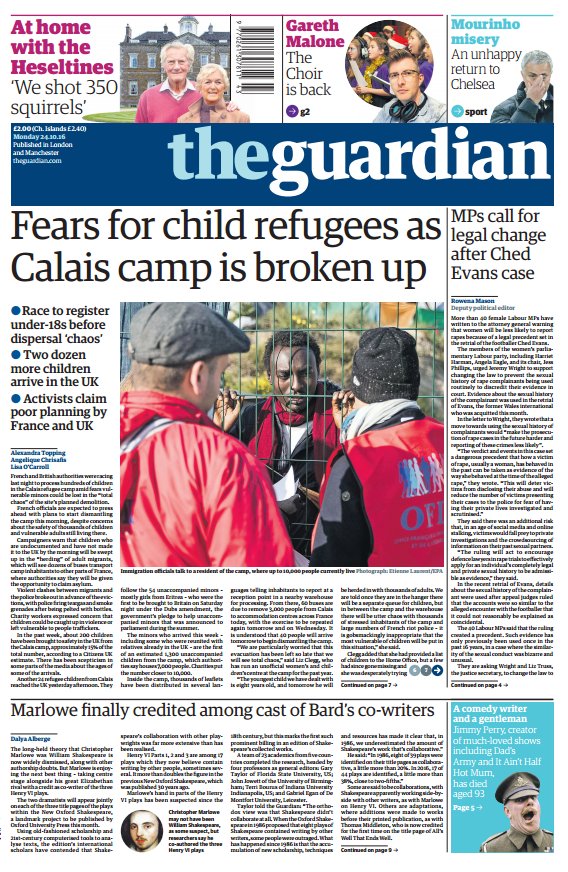
This completely contrasts to the below images of The Guardian front covers. The upsetting images on the front covers reflect what The Guardian wants society to see. They show refugees/migrants in a positive way as people who are just trying to protect their families and seek refuge in a safe country - Britain.

Image result for guardian front cover on calaisImage result for guardian front cover on calais

Even though each of these newspapers are British newspapers, they do not share a similar view on the same sensitive topic. A racial hierarchy is clearly evident in the mid-market tabloid (Daily Mail), whereas, equality is a theme that is more shown through the broadsheet newspaper (The Guardian).

TV Drama:

Stranger Things:
Lucas is the only black person shown in Stranger Things (one of the main, teenage characters in the group of friends). This clearly shows a lack of ethnic diversity in the tv drama, especially as Lucas' backstory is only begun to be shown in the third season of the tv series.

Deutschland '83:
General Jackson (the American general) is of African-American descent. Even though he is an important character in the series, he is the only black person to be shown in the first episode in West Germany. In showing this lack of ethnic diversity, the tv drama is clearly showing the attitudes towards black people at that time in Germany (the 1980's).

Usefulness in...

News:
Gilroy's theory is very useful when comparing the representations of ethnic minorities in the media. It is clear to see the differences of peoples attitudes in both The Guardian and the Daily Mail. It explains how society has been able to shape each others opinions based on their contemporary views of the continuous topic.

TV Drama:
Gilroy's theory is, again, very useful as it links to the lack of ethnic diversity during the 1980's in America and also in Germany. It explains how there is a clear racial hierarchy between white and black people. this is influenced by the fact that there are many more authoritative white people in charge throughout both ST and D83.


Monday, November 12, 2018

News values

> Threshold - the bigger the impact and reach of the story
> Unexpectedness - an event that is a shock or out of the ordinary
> Negativity - bad news is more interesting 'if it bleeds, it leads'
> Elite persons/places - stories about important people and powerful nations
> Unambiguous - stories that are easy to understand and for papers to report on
> Personalisation - stories that include human interest - 'real' people
> Proximity - stories that are closer to home that are more likely to be included
> Continuity/currency - stories that are already in the news continue to run and are updated

C     U     P     P     T     U     N     E     =     ACRONYM

GUARDIAN and DAILY MIRROR comparison

QUESTIONS
THE GUARDIAN
THE DAILY MIRROR
Who was involved?
Bidhya Sagar Das, the mother who is not named, a witness and twins (1 boy and 1 girl).
Bidhya Sagar Das, Gui Gui (witness), baby boy Gabriel, baby girl Maria and Cristinela Das.
What happened?
Bidhya killed the one-year-old boy with a hammer and his sister was critically injured.
Child dies and his sister is critically injured. Investigators await results of post-mortem exam.
A man has been held over a suspected hammer attack on twin toddlers that killed one and left the other fighting for life.
Where did it happen?
Finsbury Park, North London.
Property in Hackney, North London.
When did it happen?
Saturday 18th March 2017, late on the Saturday. The police were called at 11:10 pm
Saturday 18th March 2017. At 11:10 pm that night, the mum ran into the streets screaming.
Why did it happen?


What do you notice about the difference in content and how the articles convey this information? Why do you think that is?
The article does not go into a lot of depth about why and how the incident happened. There is more information on the witnesses and the later events that weekend. The article also does not include the names of the twins. There is much more text in this article.
There are larger images in this article to make it stand out how children are involved. By using a large image of children, it automatically creates an emotional aspect of the article and the story. Witness quotes are used in the article. Article is more emotional and less informative.

Monday, November 5, 2018

News

Online - The Guardian and Mail websites
Social - Twitter, Instagram and Facebook feeds/comments

Jean Baudrillard - Post Modernism theory + application of usefulness

Baudrillard's theory: - The idea that in postmodern culture, the boundaries between the 'real' world and the world of the medi...